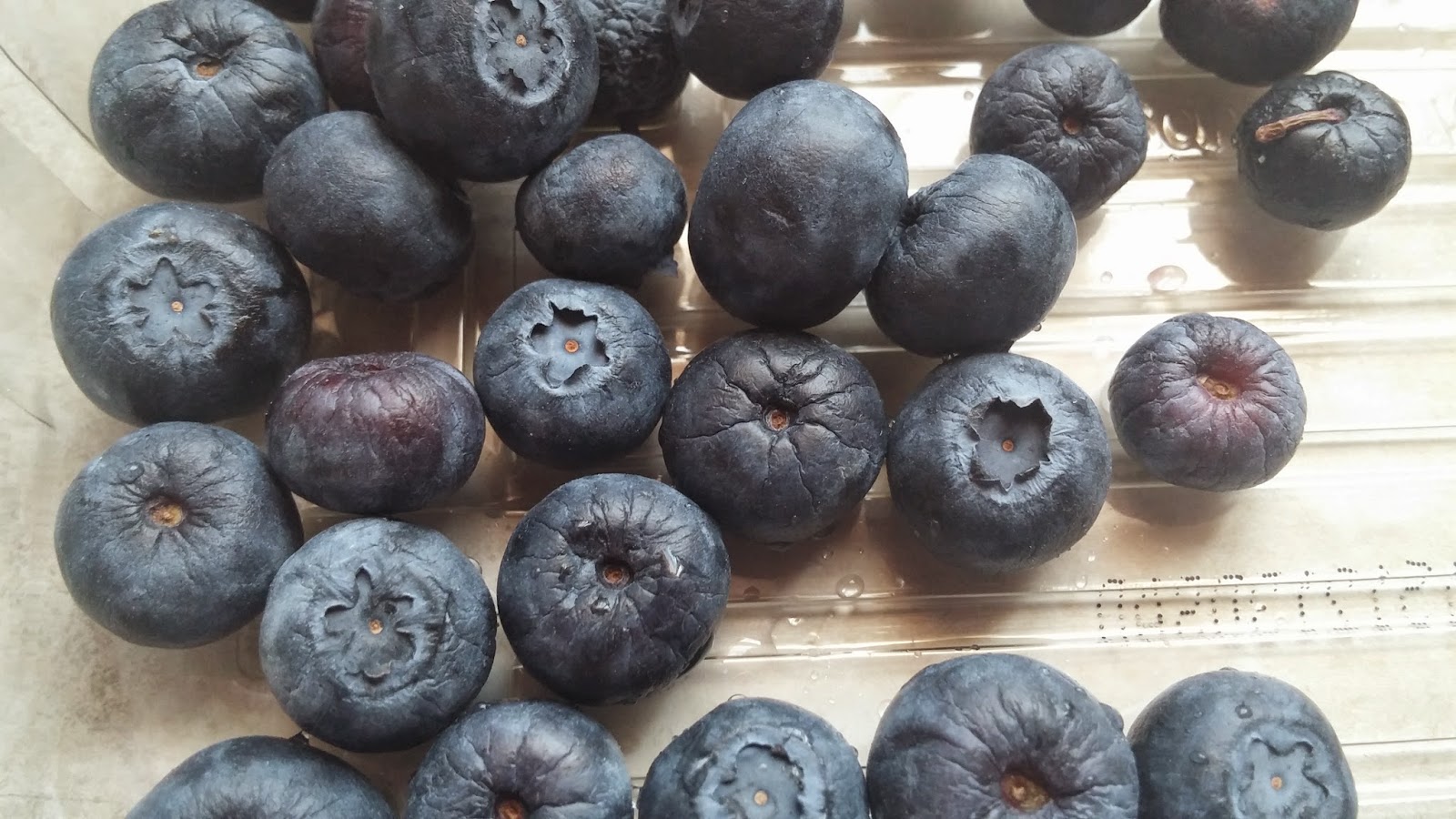
Question of the day: what do fruits like blueberries, raspberries, and strawberries all have in common?
Well, if their names are anything to go by, they are all berries; yet that seems to be where the commonality ends.
Color-wise, shape-wise, and texture wise, they are all pretty different from one another aren't they? One is dark blue in color, tiny and round in shape, and smooth in texture, another is (in its most commonly-known form) dark red, ovular, and bumpy, while the last is bright red, triangular, and leafy with little pits embedded in its surface.
Perhaps a cross-sectional view will offer more insight then? As you can see below however, these fruits are just as different on the inside as they are on the outside. Perhaps the way they grow then? That too further exemplifies their differences as blueberries grow on bushes, raspberries are perennials with woody stems, while strawberries produce runners (whose growth are akin to that of a vine's). Well then, you may be wondering, what exactly makes a berry a berry?
Culinarily (and in everyday English), a "berry" refers to a small, round, seedless/pitless fruit, such as the aforementioned ones. Botanically however, a "berry" is defined as a fleshy fruit that has developed from a single flower and contains one ovary. Raspberries, on the other hand, develop from the merging of several ovaries. Likewise, the seeds of a berry are often found embedded within its flesh, but if you examine a strawberry, the yellow pits dotting its surface are in fact the actual fruit containing the seeds. In other words, of the three featured "berries,"--blueberry, raspberry, and strawberry--the blueberry is the only one considered a "true" berry.
In following with the botanical definition, other "true" berries include--believe it or not--grapes, avocados, even bananas--all of which grow from a single flower and have a single ovary, with their seeds (or pit) embedded within their flesh. In fact, a berry-bearing plant is referred to as
bacciferous or
baccate from the Latin
bacca, meaning berry. And for those of you familiar with Roman mythology, Bacchus (Dionysus in Greek mythology), whose name is related to
bacca, was the god of wine (and what is wine made of but grapes, which are in fact considered "true" berries).
Where does that leave raspberries and strawberries then? As mentioned before, raspberries develop from the merging of several ovaries making them (and other fruits like them such as blackberries) aggregate fruits. So each of those round little spheres that makes up a raspberry is actually its own little fruit with its own little seed (which you can see if you look closely). Strawberries, also under the category of aggregate fruit, are aggregates of achenes, the yellow speckles on its surface (often mistaken for seeds). However, strawberries can also be considered an accessory fruit in that its flesh is not developed from the solely ovary alone, but from other parts of the plant as well.
So what do blueberries, raspberries, and strawberries all have in common? Culinarily, they make for great jams, pies, and smoothies, and also complement waffles, pancakes, ice cream, and yogurt quite well. Botanically, however? Besides being fruits, not much else. Only the blueberry is a "true" berry, while the other two are aggregate fruits. Now, isn't that something else? And with that, I leave you all with a little food for thought:
Until next time~
Sources
"Berry." Wikipedia. Wikipedia. Web. 06 February 2015 <http://en.wikipedia.org/wiki/Berry>.
Ehler, James T. "True Berries: Facts & Trivia: Berries & Fruits." FoodReference.com. FoodReference.com. Web. 06 February 2015 <http://www.foodreference.com/html/f-berry-trivia.html>.
Lorge, Greta. "Bananas are Berries?" Stanford Alumni Magazine. Stanford University. Web. 06 February 2015 <https://alumni.stanford.edu/get/page/magazine/article/?article_id=63171>.
P.S. If you're like me and like to post multiple pictures side by side, I recommend this very helpful and easy-to-understand
blog post.